3-2-1 Countdown: A Tabletop Tales Review

Guys. Guess what? I won a giveaway!

Grandpa Beck’s is a pretty fantastic card game company. I love the “family feel” they exude, and I really love that their games come at such a great price point. (Our first introduction to Grandpa Beck’s was through a friend who gifted us a copy of Skull King, a pirate-themed, trick-taking game at its finest. I’m digressing, though. Let me leave that review for another post.)

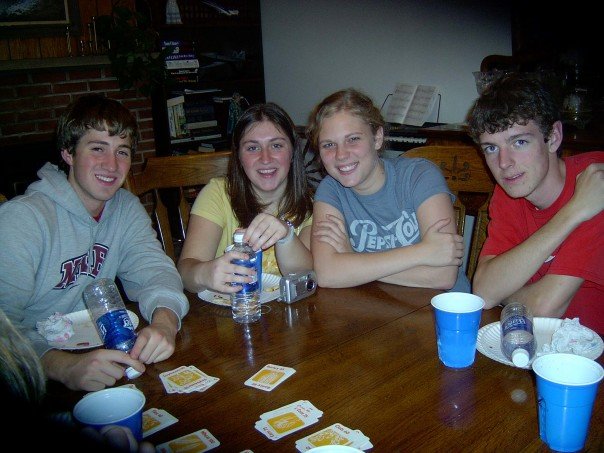
Earlier this month, Grandpa Beck’s launched a brand new card game called 3-2-1 Countdown! I follow several board game accounts on social media, and three of them were offering giveaways prior to the launch date. I entered the giveaways with zero expectation of winning anything. (The last time I ever won a raffle was at a “Take Your Kids to Work Day” event with my grandma. I was 10.)

Well, the stars and the planets aligned for me or something because one of the Instagram accounts I follow messaged me: “Hello there! Guess what?! You won my giveaway for 3-2-1 Countdown! Congratulations!”

Eek! My 30-year “losing streak” is over, and I’ve won something so.majorly.cool. I’m all about games that are easy to teach, quick to learn, and fun to play. This checks all the boxes.

Speaking of boxes… Grandpa Beck’s games bring an added bonus: they come in small boxes! As a blossoming board gamer, I’m already finding that we’re running out of space for our growing collection. Compact games like this one score extra points in my book.

Keep reading if you’d like to check out some more details about 3-2-1 Countdown!


Number of Players: 2-8 / Recommended Age: 7+

Playing Time: 15-30 minutes

Object: Reduce the total value of the cards in your hand to 5 points or less.

Rules: Get a general idea of gameplay below, or you can check out this link to Grandpa Beck’s “How to Play” video.

For 2-6 players, deal out 12 cards to each person. The rest of the cards go to the middle of the table. Form a discard pile on either side of the draw pile.

On your turn, you’ll do two things. Discard first! Place one of your cards on either discard pile. (If you’ve got multiple cards of the same number, you’re allowed to get rid of the entire set.) Secondly, draw a card from the other discard pile – or from the draw pile.

Take turns discarding card(s) and drawing a new card until a player has 5 points or less in hand. That player can yell, “Countdown!” and end the round. (Alternatively, you could win another way. If every card in your hand is the same number, you can discard all of your cards and call out “Blastoff!”)

All players will then add up the face values of the cards in their hands. The person with the lowest total receives 3 points, the second-lowest gets 2 points, and the third-lowest gains 1 point. However, you’ve got to be careful. If you call “Countdown!” but don’t have the lowest score, you get nothing. Zilch-o. Nada.

You’ll have to take some risks if you want to win big!

Ang’s Rating: 8.5/10

ANGELA15

Using the above coupon code when you check out will get you 15% off your order!
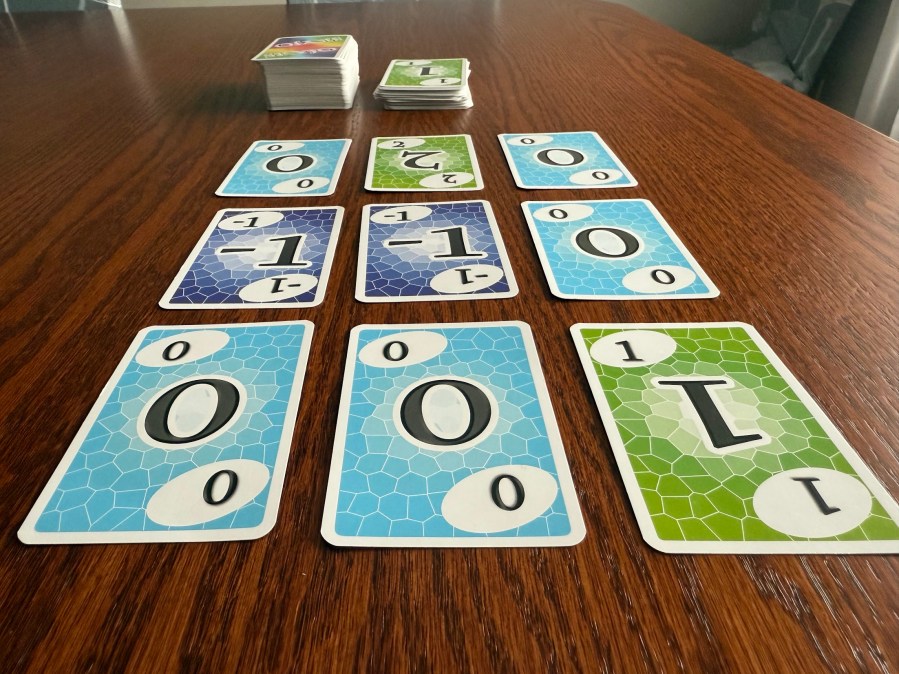
Skyjo: A Tabletop Tales Review

Cal walked in while I was uploading some pictures for this blog post and said, “Whatcha doing, Mom?” I told her I was getting ready to share yet another game. As she looked over my shoulder, she incredulously asked, “You mean, you haven’t posted about Skyjo yet?!” We all really, really like this one!

Whenever I’ve got a game night to attend, I often lead with this game. It’s easy to walk a person through a practice round without having to explain a ton of rules. I also love that up to 8 people can play, and the rounds are fairly short.

I can think of two other games that are comparable to Skyjo: Grandpa Beck’s Gnoming Around and Play Nine. If you already own either of those, I don’t think you need to buy this too. The mechanics of all 3 games are similar. I just happened to get introduced to Skyjo first; I fully own my bias.

I’m trying my hardest to come up with some kind of “negative” about the game so that I’m being transparent about the pros and the cons… but I’m kind of at a loss! It’s solid!


Number of Players: 2-8

Age: 8+

Playing Time: 30ish minutes

Object: Get the lowest score as quickly as possible by flipping, exchanging, and revealing cards.

Rules Rundown: Here’s a link to an unofficial copy of the rules – or follow along below for a quick run-through of how to play.

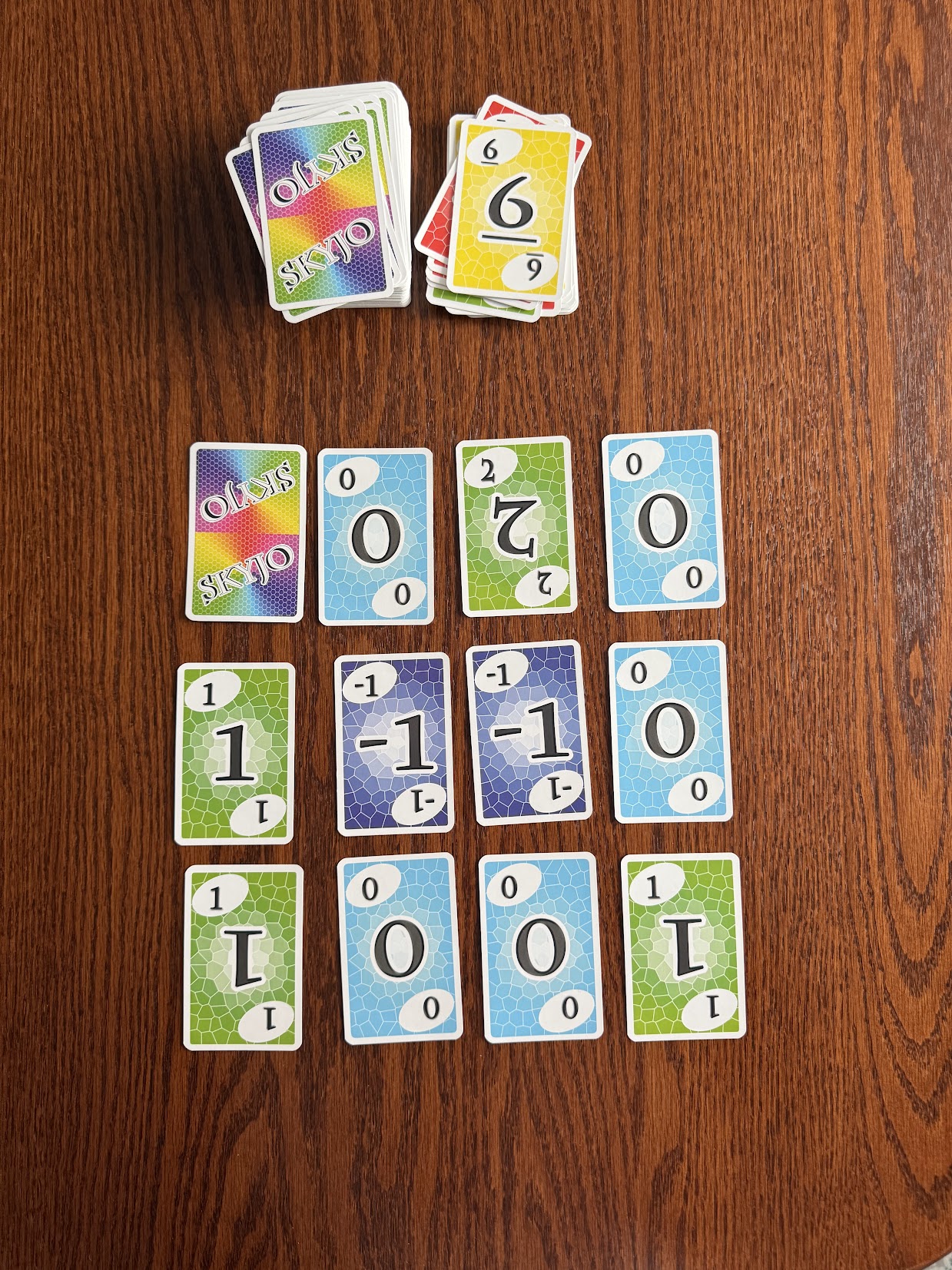
First, deal out 12 cards to each person. Every player will make a facedown 4×3 grid. Before play begins, flip up any 2 cards. Place the draw pile in the middle of the table. The person who has the highest point total showing will go first.

On each turn, draw a card from the draw pile or from the discard pile. After looking at that card, decide if you would like to keep it or not. If you want to add it to your grid, you must exchange it with one of your current cards. It doesn’t matter if the card is hidden or not. (Obviously, you are taking a risk if you decide to replace one of your hidden cards, but sometimes the risk pays off!) You can also decide to discard the card you chose, but if you do so, you’ll automatically flip up one of your hidden cards.

There is one special feature. If you happen to place 3 identical cards in the same column, they cancel out! Discard those 3 cards, eliminating the column and bringing your total score down.

The round is basically over when someone has flipped over all of his cards. (Any players who did not get to finish the current round are allowed to take one final turn.) Turn over any remaining hidden cards, tally up your points, and write them on the score card. *Important! If the player who went out does not have the lowest score, he must double his score. Yikes!

I hope you enjoy Skyjo as much as I do!

Ang’s Rating: 8/10

Donuts: A Tabletop Tales Review

A simple one on the blog today: Donuts! This cutely designed game is honestly just a glorified version of tic-tac-toe. Since it comes in at a cheaper price point than other games, I’m here for it!

I’ll be honest. This isn’t the first game I’d choose if I’ve got friends coming over for a game night, but it does serve a fantastic purpose: filling up time. If you’ve got kids in your life who have ever uttered the words “I’m bored,” then Donuts might be a great option. I recently took it with me to a restaurant and played with a kiddo while we waited for our food to arrive. I love that it’s so easy to learn!


Number of Players: 2

Age: 7+

Playing Time: 5-10 minutes per round

Object: Get five donuts of your color in a row!

Rules Rundown: Here’s a link to a 3-minute video explaining the rules – or follow along below for a brief overview.

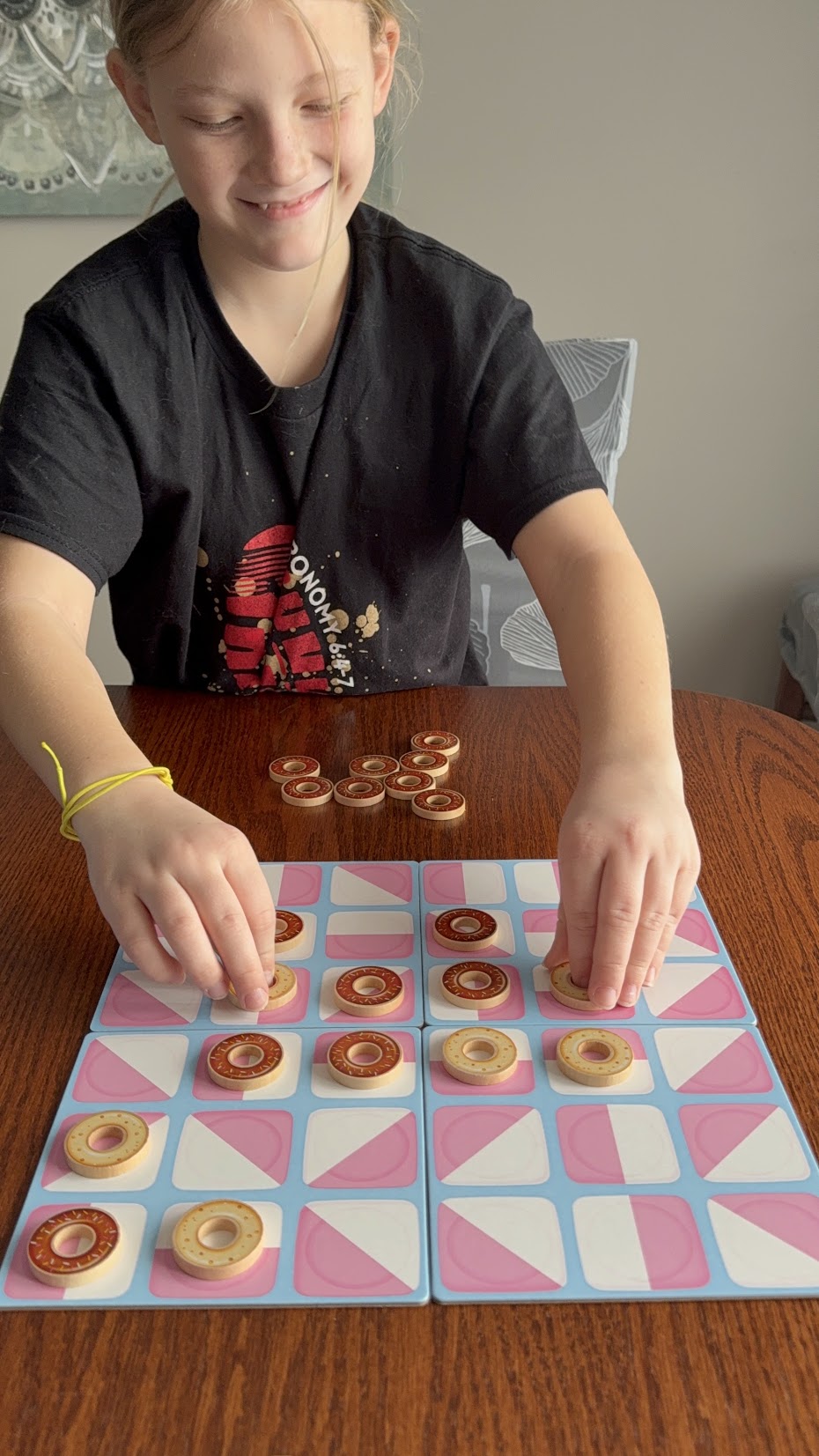
First, you’ll divide the double-sided donuts evenly. Fifteen go to each player. Choose chocolate or vanilla. The first player places a donut anywhere on the board. Player 2 must now put a donut in the row that was indicated by player 1’s donut.

From there, continue taking turns, placing donuts in the indicated row. If a row is completely filled so that a player cannot place a donut, the player may put his or her donut anywhere on the board!

There is one other small component that can change up the game at a moment’s notice. If you are able to insert a donut in between two of your opponent’s donuts, then you can flip over those two donuts that are bookending your donut, enhancing your chances of winning!

That’s it! This is a little more strategic than your normal tic-tac-toe game but still easy enough for kids to jump in.

I do not think is an absolute “must” to add to your game collection, but I do think it would make a great little stocking stuffer or Easter basket addition.

Ang’s Rating: 6.5/10
Cal’s Rating: 7.5/10

Calico: A Tabletop Tales Review

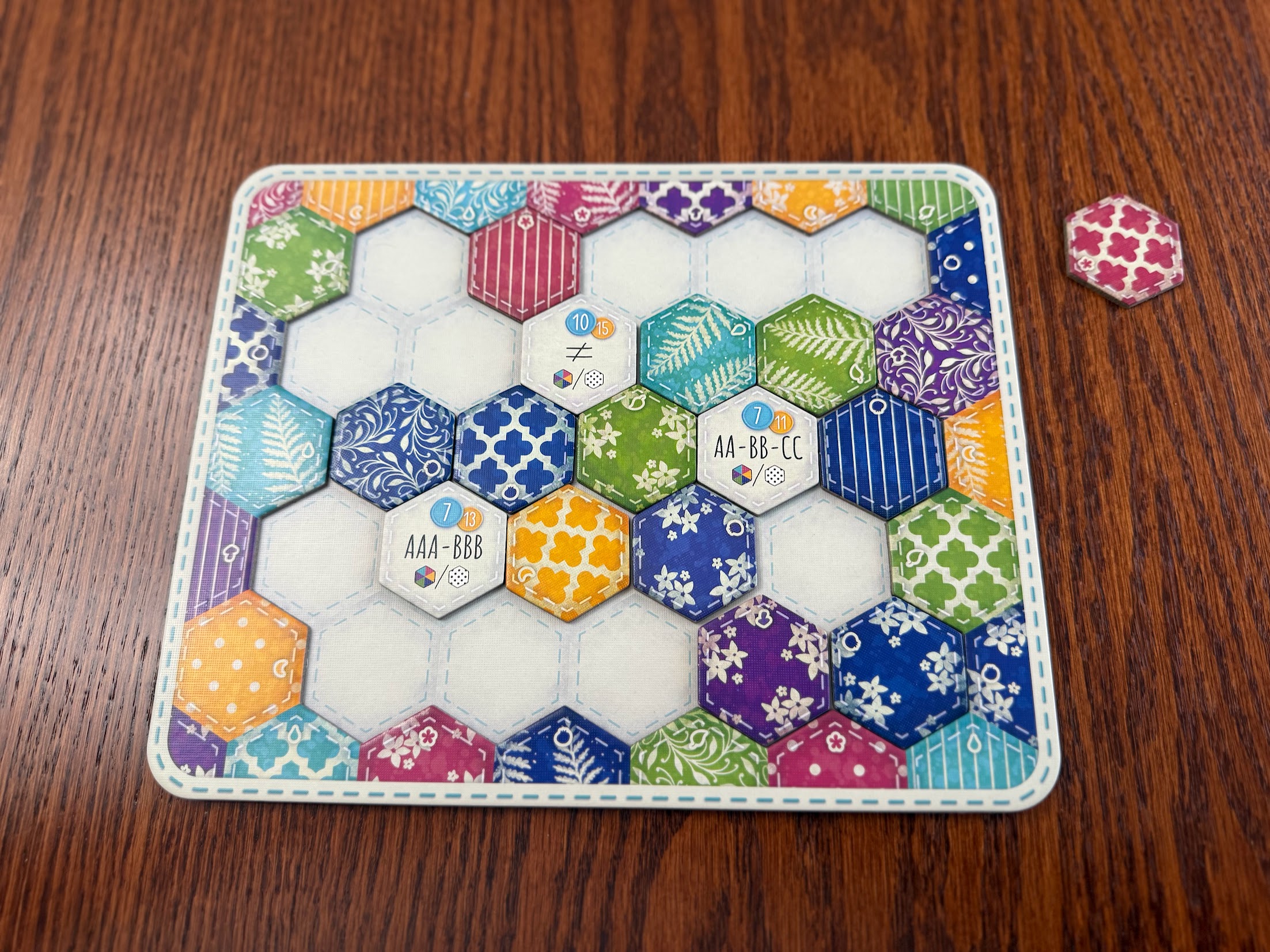
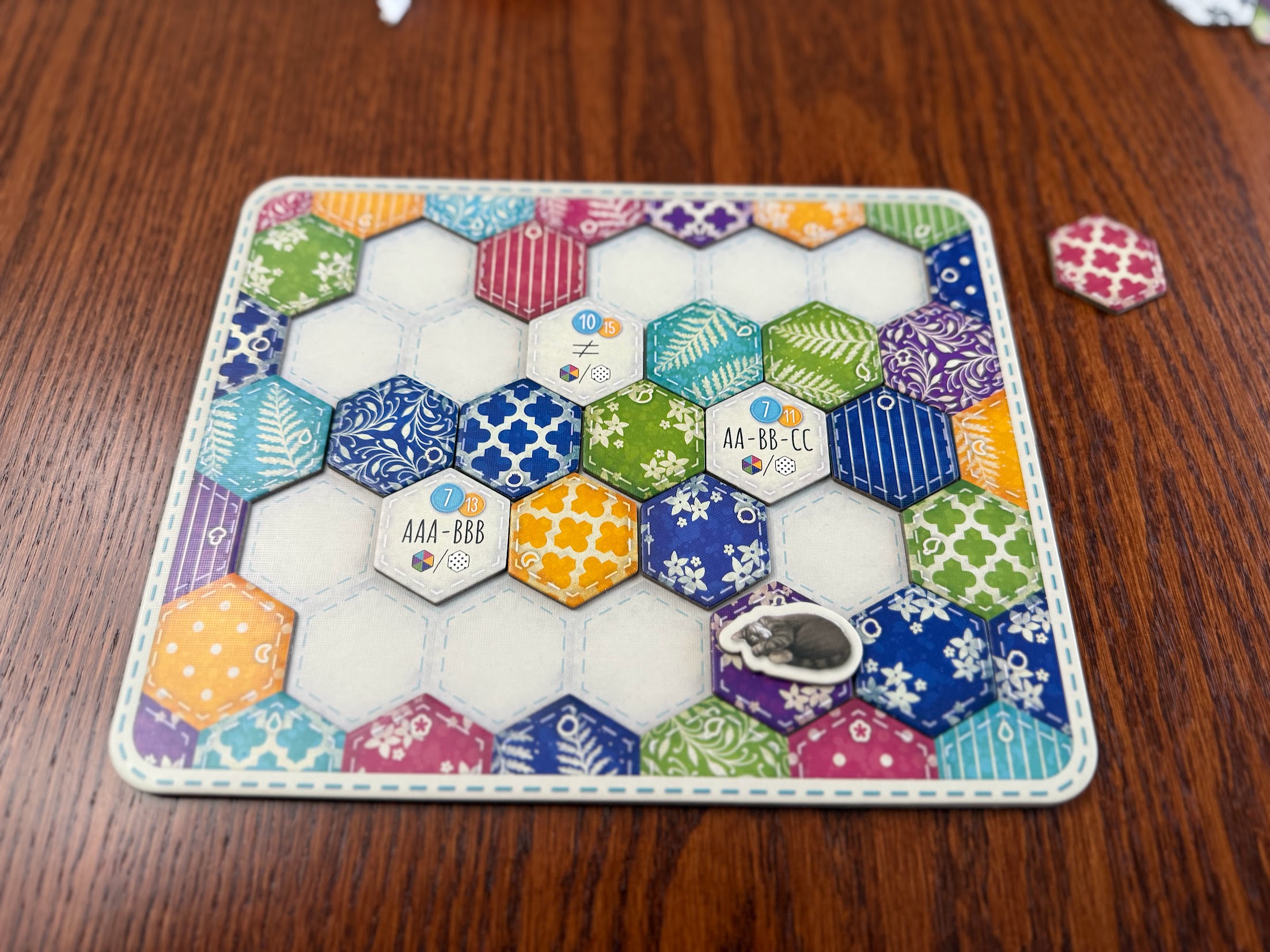
Guys. I’ve only played this game a handful of times since buying it, but I could very easily make this one an obsession. Calico is perfectly themed for cold weather gameplay. Who can resist a cozy evening of fun with adorable kitten tiles, colorful quilts, and real-life friends?!

In the grand scheme of board game choices, Calico is on the lighter side, but it’s still both challenging and fun. The rulebook is laid out in an understandable way, and there’s a beginner version that you can play through until you feel comfortable with normal gameplay.


Number of Players: 1-4

Age: 10+

Playing Time: 30-45 minutes

Object: Lay tiles to complete patterns and earn points by sewing the best quilt.

Rules Rundown: Here’s a link to the rules – or you can get a general idea of the gameplay for the beginner version below.

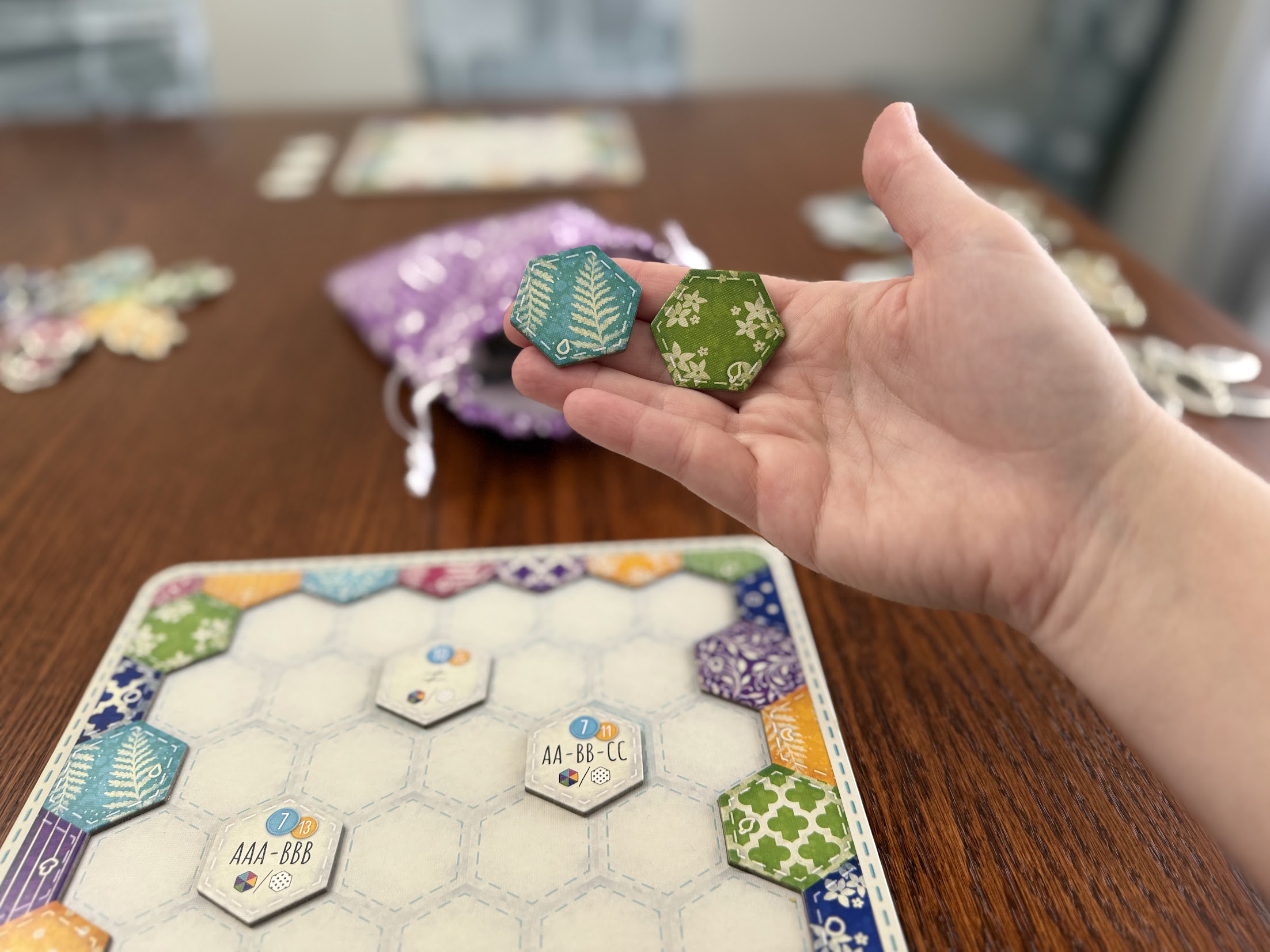
Place Millie, Tibbit, and Coconut (3 of the cat scoring tiles) at the top of the table – along with their matching mini cat tokens. Randomly place 2 black and white pattern tiles under each cat tile. (These are the patterns that each cat “likes” for this game.)

All patch tiles can be placed in the bag, and button tokens can be placed in the middle of the table.

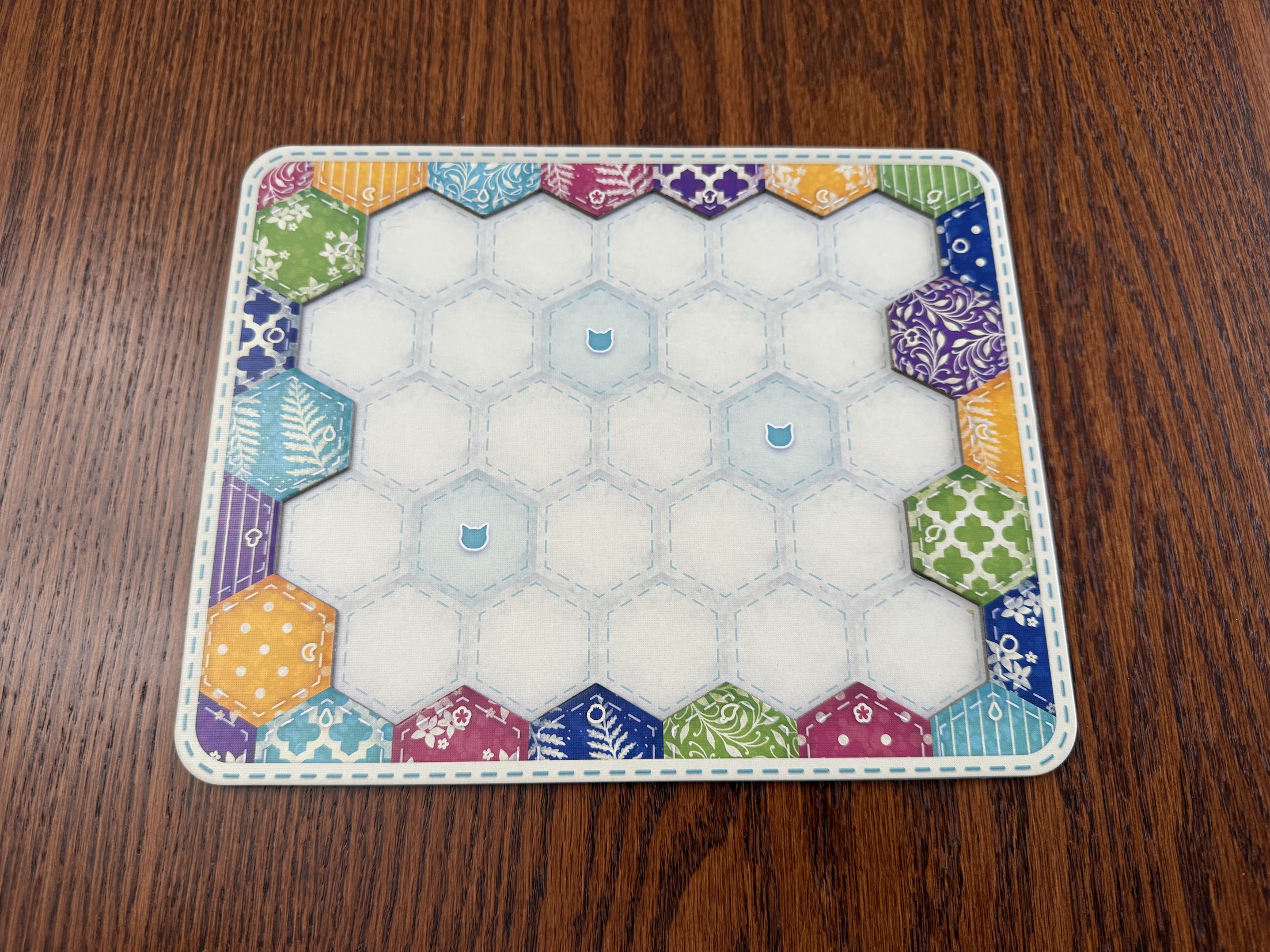
Each player receives an empty quilt board. Pick out the 3 designated design goals and place them in their correct locations on the quilt board. Everyone works toward completing the same designs on his own board in the beginner version.

Draw 2 patch tiles from the bag and place them next to your quilt. Each turn, you will lay one of your tiles anywhere on the board, attempting to strategically place it somewhere that will help you complete your design goals. You’ll end your turn by drawing a new tile from the “market” (aka, the bag).

That’s the gist of it! There are some other components (you can receive additional points – in the forms of buttons and kittens – for connecting colors/patterns of specific quantities), but the basic gameplay truly is a simple process: draw a tile, place a tile, and replenish your tile.

To be completely transparent, Scott isn’t a huge fan of the theme. (I mean, what almost 40-year-old man wouldn’t think that trying to attract cats to a quilt is his idea of a good time?! Heh.) At its core, its just another drafting game, so the hubby is willing to overlook the crazy kitties for my sake. My older two kids can handle gameplay without help, but my 9-year-old loses interest if we’re playing at the 4-player max.

There is also a single-player version of the game that I’ve tested out. I give it a thumbs up! For me, this game has been solid add to my collection.

Ang’s Rating: 9/10

Shifting Stones: A Tabletop Tales Review

If you play games often, then perhaps you’re “moody” like me. Sometimes I want a game that is complex and deep; the challenge is the draw. Other times, I just want a light and easy game; spending time with others is the priority.

Shifting Stones definitely fits into that latter category. While it’s technically a competitive game (there is one winner), it doesn’t feel tense. When it’s not your turn, there is plenty of time to talk and laugh with others.

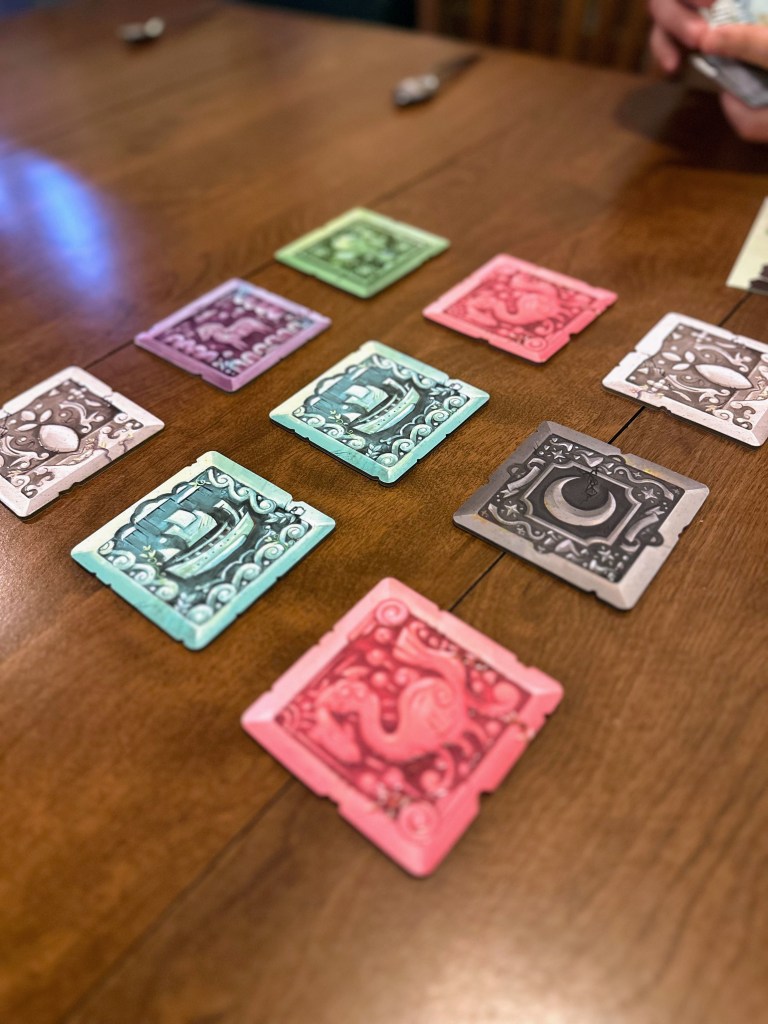
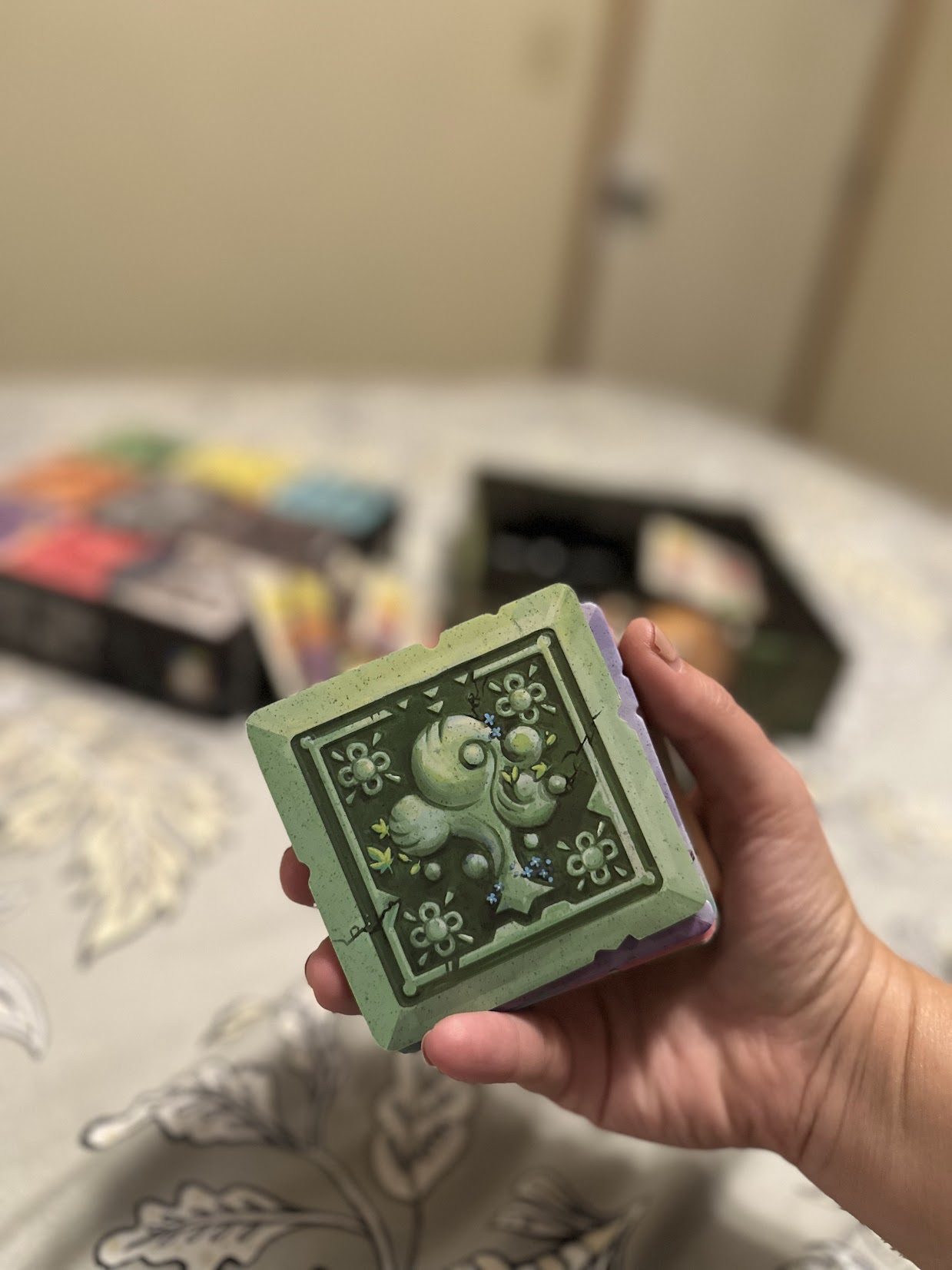
This abstract pattern game is super easy to learn, and I fell in love with its design as soon as I opened the box. The tiles are durable and interesting, and the rules are concise and well-written.

While the box states that you can play up to 5 players, I’d recommend sticking to 2 or 3 people for best results. (There are rules included for a single-player version. It isn’t too shabby – if you’re in to that sort of thing.) My biggest complaint for a game with 5 people is that the wait time between turns feels a bit long. Of course, people want to strategize and think through their moves, but the board will change by the time it gets back around to you. It feels like there’s no point in strategizing until the player directly before you is moving tiles.

I’ve included some of the specifics of the game below.


Number of Players: 1-5

Age: 8+

Playing Time: 20ish minutes per round

Object: Form patterns within a 9-tile grid to score the most points.

Rules Rundown: Here’s a link to a digital copy of the rules.

Set up the board by randomly placing the 9 double-sided tiles in a 3×3 grid. Pass out 4 pattern cards to each player. On your turn, you can perform any number of the following actions using your 4 cards:

  • Flip a tile (by “paying” with one of your pattern cards)
  • Move a tile (by “paying” with one of your pattern cards)
  • Score points for completed patterns

If you want, you can skip your turn in order to draw 2 additional cards, bringing your hand up to 6 cards. However, you cannot skip twice in a row.

When you’re finished with your actions, draw your hand back up to 4 cards so you’re ready for your next turn.

Rating: 7.5/10

Overall, I think it’s a great addition to your game collection – especially for the price!

Pit: A Tabletop Tales Review

I’ve been called an old soul on occasion, and I’m not even mad about it. From books to music to movies, I will pick “classic” over “modern” 9 times out of 10. Apparently, enjoying really old games is wrapped up in my old soul vibe. Today’s featured game is Pit, and it’s probably the “oldest” game we own. It was first published 120 years ago!

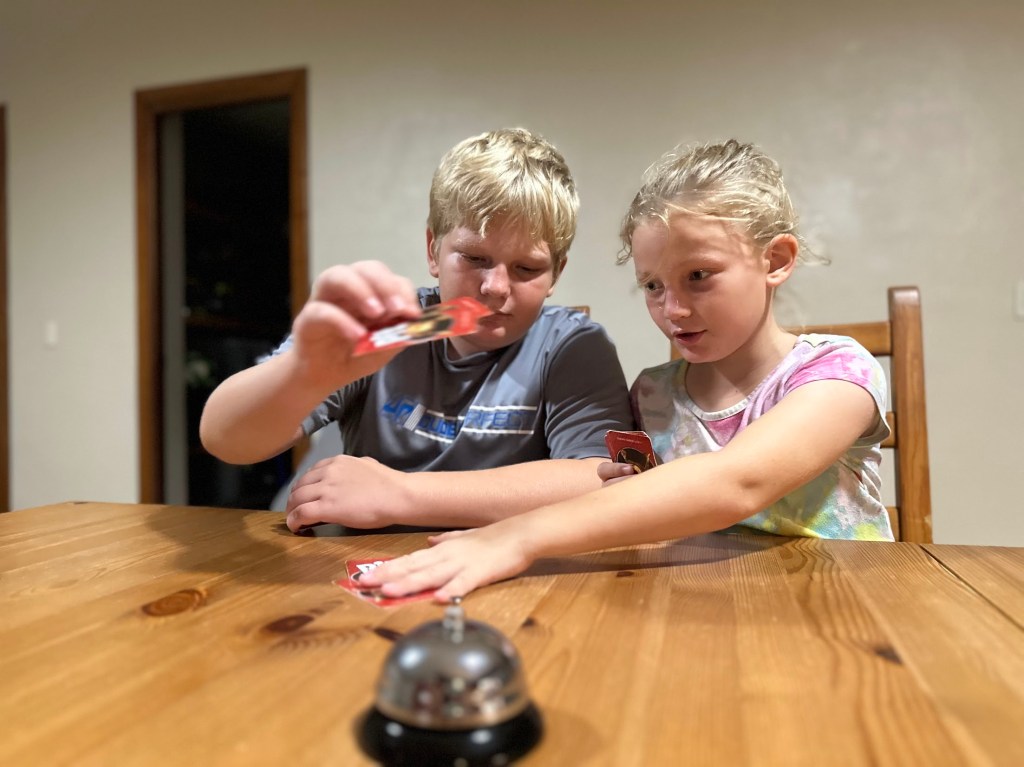
I remember playing Pit often as a kid. I’ll always have a soft spot for the 1973 edition my family owned, complete with its mustard-colored artwork and bright orange bell. I imagine I drove my parents batty dinging that bell every chance I’d get.

Scott and I have tried to be intentional this year about making Thursday game nights a priority for the fam. While I wouldn’t characterize my children as old souls, they do enjoy a good game of Pit. To up the ante last Thursday, I offered them an added incentive: whipped cream! Whoever won each round got a shot of whipped cream straight from the can. Yes, I bribe my children with sweets and junk food.

Back to the game. Pit is a set-collection game that relies heavily on your ability to negotiate in a chaotic, real-time environment. Think Wall Street. In my opinion, the more people that play, the better the game. Generally, I enjoy peace and quiet, but tranquility is not the name of this game. If you’ve got young kids you put to bed early, I’d advise choosing something else to play, because this.gets.loud.

You can check out some more Pit details below. Prepare to embrace the chaos, and enjoy some time with your friends and family!


Number of Players: 3-8

Age: 7+

Playing Time: 30-60 minutes

Object: Be the first person to “corner the market”: collect all 9 cards of the commodity of your choosing.

Rules Rundown: Here’s a link to a digital copy of the rules.

Deal out the deck to the players. Use only the number of commodities as there are players. (If 4 people play, choose 4 commodities. If 7 people play, use all 7 commodities.) Players’ hands will not be even if you choose to play with the “Bull” card and the “Bear” card. After organizing your cards, decide which commodity you will attempt to collect. (You can change your mind at any point during play and choose to go for a different commodity.)

When the dealer strikes the bell, the exchange is open. Players can simultaneously begin trading anywhere between 1 and 4 commodities – just make sure that all cards in that trade are of the same commodity. Once you have all 9 cards, you ring the bell, and you’ve won! Easy peasy!

Count up your points. If you collected all 9 oats cards, for example, you’ve gained 60 points; if you win with wheat, you’ve gained 100 points. The first player to 500 wins the game.

The Bull and Bear are special cards that add a bit of extra fun to the madness. The Bull acts as a Wild of sorts. If you have 8 cards of one commodity plus the Bull, you can still corner the market (i.e., a “Bull corner”). If you have all 9 cards of a commodity plus the Bull, you can call a “Double Bull corner” and double the score of the commodity collected.

The Bear is never helpful. Get rid of that thing as quickly as possible! However, if you have the Bear OR the Bull in hand when someone else calls “Corner,” you must subtract 20 points from your score.

Ratings:
Ang – 7/10
Noah – 7/10
Leyton – 8/10
Caleigh – 10/10

Spy Alley: A Tabletop Tales Review

In recent years, I’ve had this low-key desire to someday become a spy. (Hah! I think I’ve read too many WWII novels or something.) When I stop to think about it, I suppose the spy life isn’t truly for me. But taking on another identity sounds so adventurous and exciting, doesn’t it?

Today’s review is all about Spy Alley! This simple deduction game gives me the opportunity to try out my bluffing skills on my kids at a low-stakes level; no government agencies are counting on me to deliver an important package to a dead drop under the cover of darkness.

My mother-in-law bought us this game for Christmas years ago. I had never heard of it and was a little skeptical that we would get much play time out of it, but it has truly been a light, fun addition to our game collection! These last two weeks, the boys have brought it out multiple times, and they’ve even taught some friends how to play.

Spy Alley definitely has Monopoly vibes. Thankfully, it is MUCH shorter than a typical Monopoly game, and you get the added fun of bluffing/trying to deduce the identities of the other players. This doesn’t have super high ratings on BGG (5.7 avg), but it has most certainly become a Mitchener family fave.

For me, there is one “con” in this game. It’s entirely possible to get eliminated fairly early if someone makes a lucky guess about your identity. If the rest of the game goes long, any eliminated players must obviously wait to start another round. My kids have generally found that it’s worth the wait!


Number of Players: 2-6

Age: 8+

Playing Time: 30ish minutes

Object: Take on a secret identity, collect the necessary items for your country, and make it to your embassy before you are discovered by the other players.

Rules Rundown: Here’s a link to a digital copy of the official rules.

Deal a secret identity card out to each player. Pass out scorecards and $10 times the number of players. Simply roll the die and move your character the correct number of spaces. You can buy any item you land on (or win a free gift) in order to collect the password, disguise, code book, and key for your country. Each time you pass go, you collect $15.

The point of the game is to buy “extra” items to throw opponents off your scent. For example, if you are Russian, you may want to buy German and American items as well, placing them on your scorecard in order to keep your identity hidden.

At any point, instead of taking your turn, you can try to guess an opponent’s identity. If you guess correctly, your opponent is out of the game, and you collect all of his or her money, cards, and scorecard items. In addition, you have an important decision to make: will you take on your opponent’s identity to try to throw everyone off, or will you stick with your original identity?

If you try to guess an opponent’s identity and you guess incorrectly, unfortunately you are out of the game. There is one exception to this immediate elimination. If you land on the Spy Eliminator Space, you receive a “free guess” on any player who is also in Spy Alley. If you guess wrong, there is no penalty!

Ratings:
Scott – 8/10
Ang – 8/10
Noah – 10/10
Leyton – 8/10

The Crew – The Quest for Planet Nine: A Tabletop Tales Review

Do you refuse to play board games in your house because they tear your family apart instead of bring everyone closer together? I’ve certainly experienced some tense moments when playing with particular friends or family members whose competitive genes run strong. (Yes, I’ve even endured the dreaded Monopoly board being turned over. Cue the PTSD for this conflict-averse lady right here.) I’m all about having a good time – it ain’t gotta be that way! Hah!

Drumroll please… enter The Crew: The Quest for Planet Nine. This trick-taking game takes euchre-lovers to outer space – as a team! Instead of trying to beat each other, you work together to complete missions of varying difficulty. If you understand the concepts of following suit and trump, this game should be easy to pick up. Yet, it’s challenging and addictive. In our house, we have a hard time finding a good stopping point because we’ve got to complete “just one more mission”!


Number of Players: 2-5

Age: 10+

Playing Time: 5-10 minutes per round

Object: Complete 50 missions together as a team.

Rules Rundown: To start, here is the online version of the rulebook. Below, I’ll run through one particular mission scenario so that you can get a general idea of how to play.

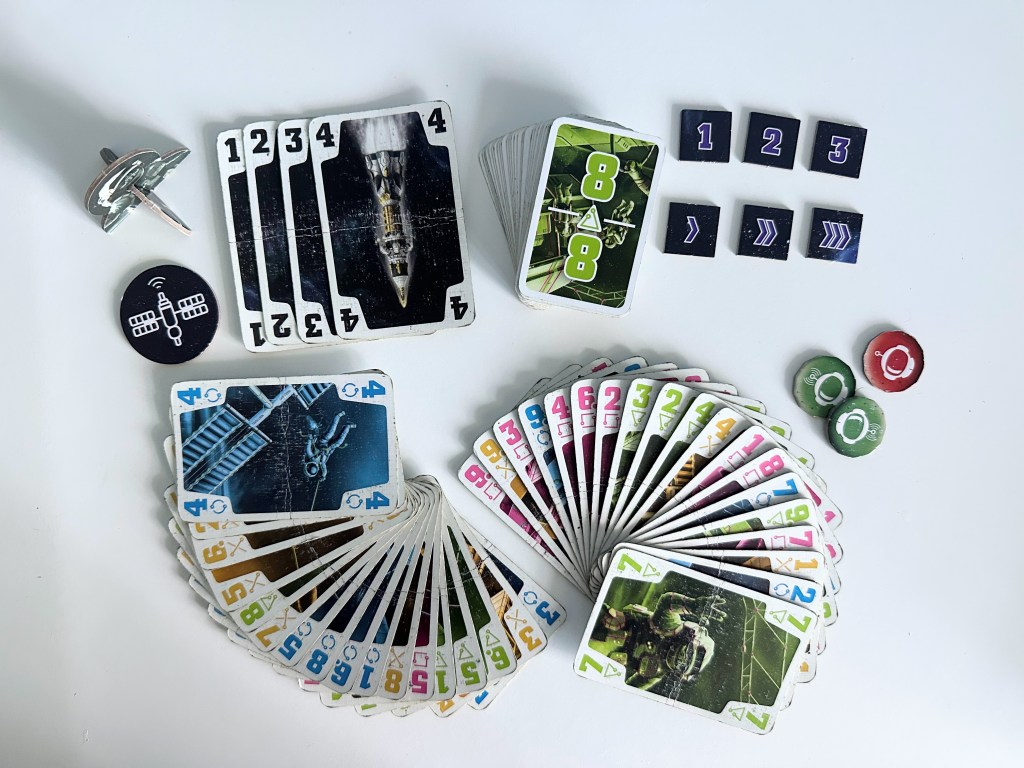
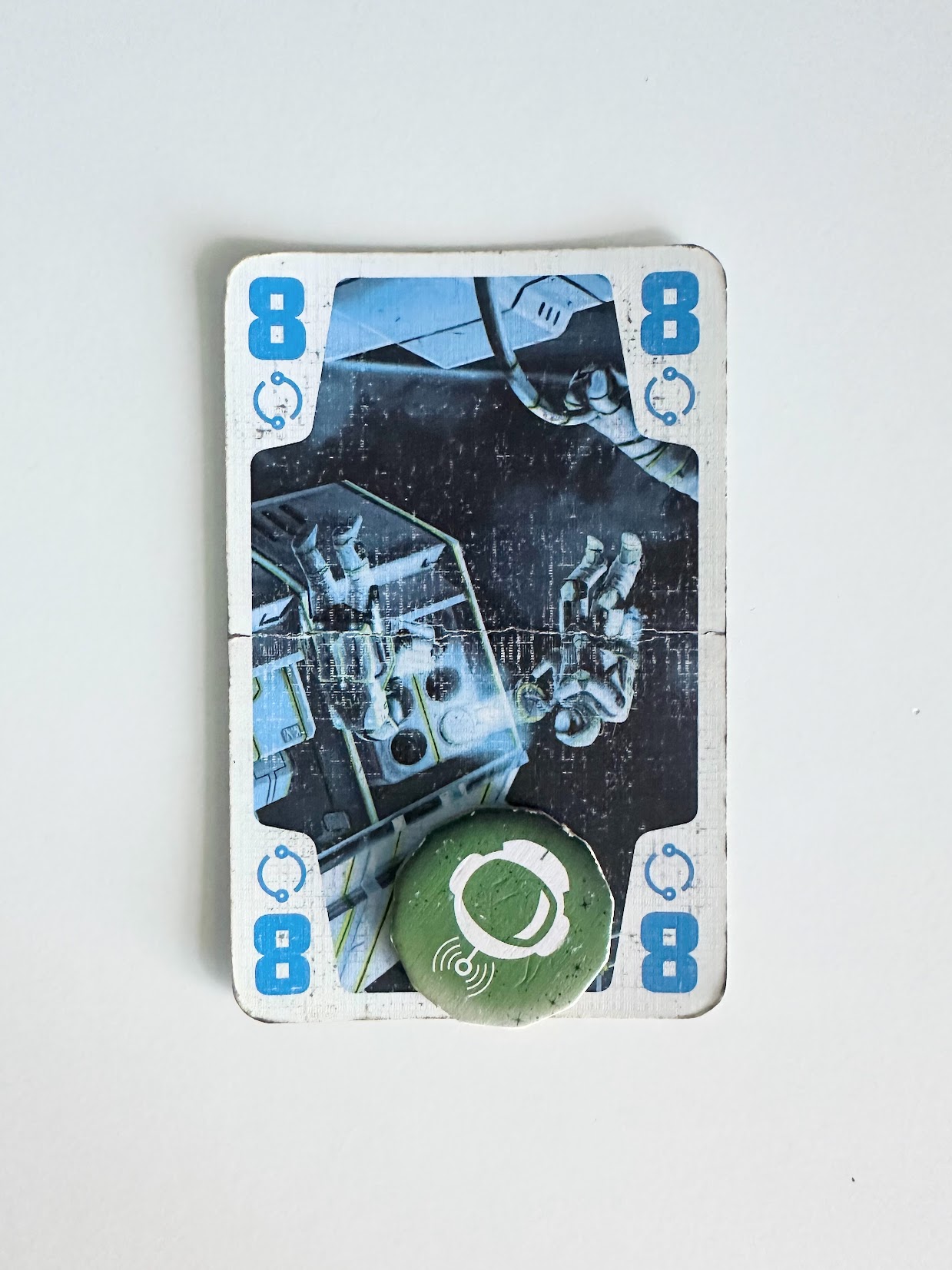
First, evenly deal out the entire deck. (The deck contains 4 suits: pink, yellow, green, and blue numbers from 1-9. There are 4 black trump cards that override any of these colored suits.)

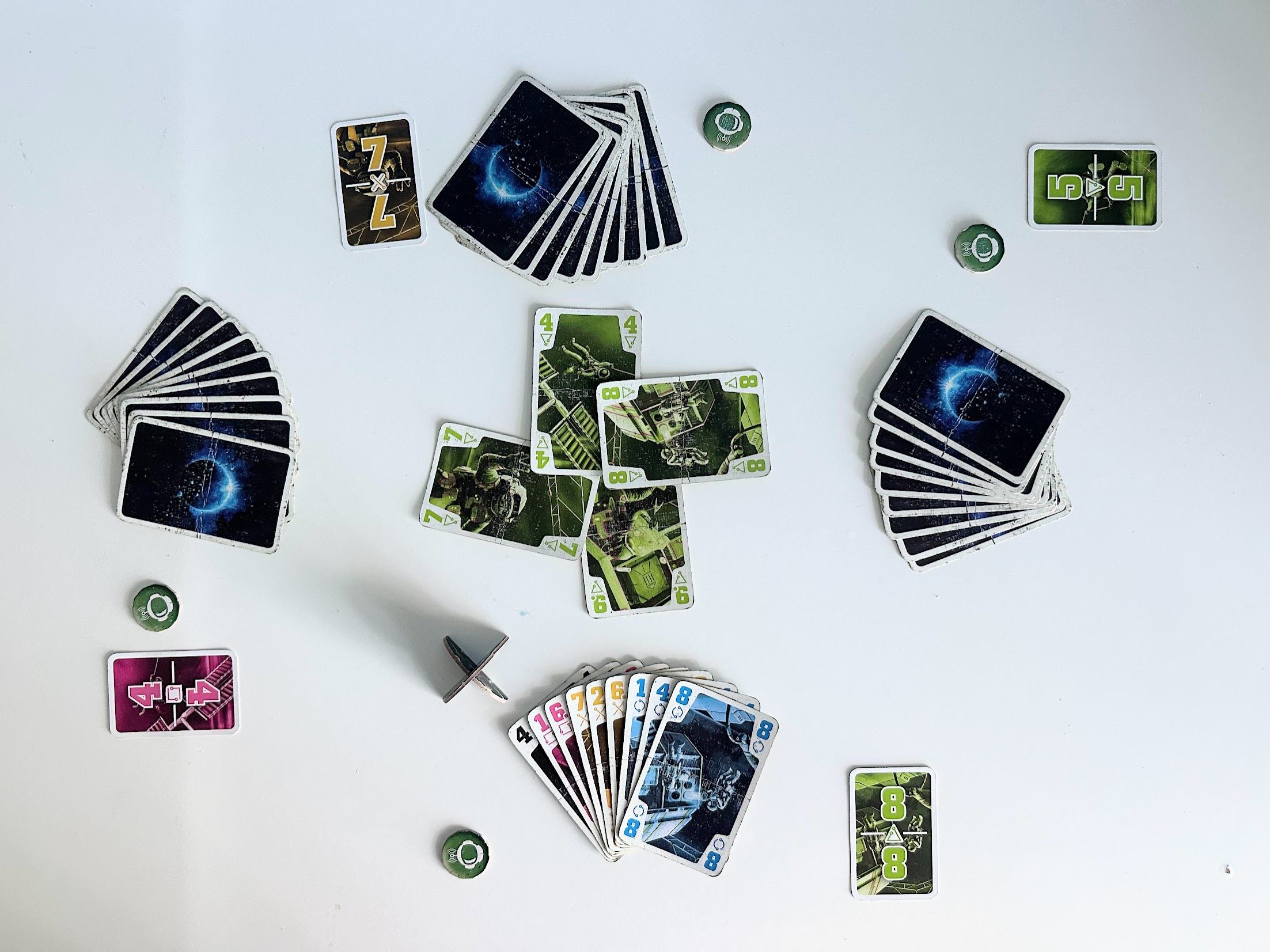
Identify who the Captain is for the round and set the Astronaut marker in front of that person. (In this example below, I am the Captain because I have the black 4 – the highest card in the game.)

Mission #10 in the Logbook asks the astronauts to flip over 4 random task cards (the smaller cards in the center of the table above). Starting with the Captain, each player must decide which of the task cards he or she could win.

I decided to take the green 8 as my task card, and I placed it in my area to remind everyone that I must win the green 8. (I chose that task card because I have the green 9 in my hand, which is the highest green card. Since I will begin the game as Captain, I can easily play the green 9 first. Everyone must follow suit, and my fellow astronaut with the green 8 should have zero obstacles to laying the 8 down for me to take.)

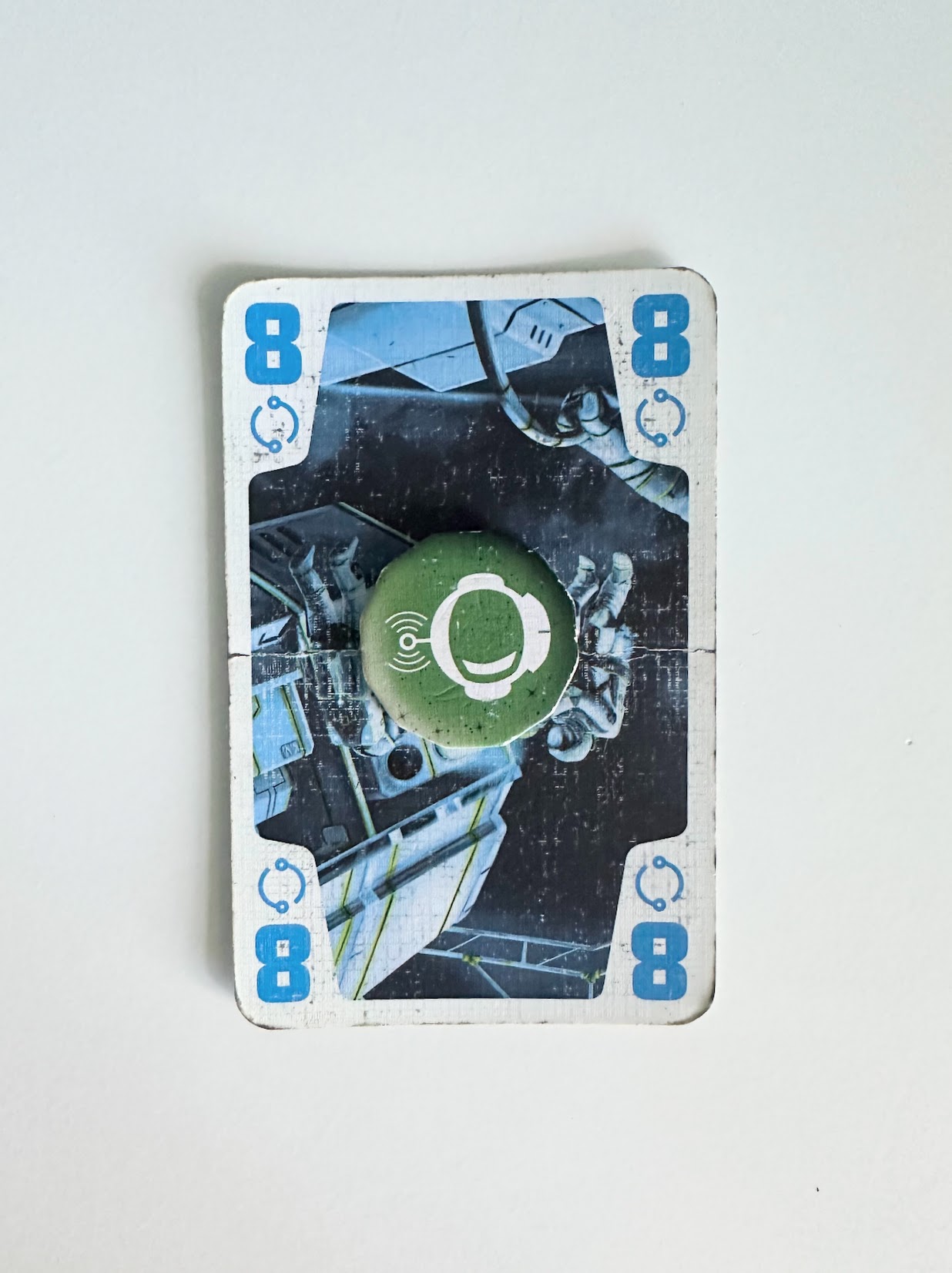
In the picture below, you can see two things happened. First, players 2-4 chose their task cards. Secondly, I decided to communicate something before we begin play.

In The Crew, each astronaut has a green communication token. Once per mission, each player is allowed to give one “clue” to the others regarding a card that is in his hand. Simply place that card on the table face up. By placing the green token on a particular part of the card, you tell the others that the displayed card is your highest card of that color, your only card of that color, or your lowest card of that color. (Above, I communicated that the green 9 was my only green card – a move that was honestly unnecessary since I have the lead.)

Getting back to Mission #10. I led my green 9, and the other astronauts all laid a green card because they had to follow suit. And look! Player 4 played the green 8; I completed my task on this mission. Now I’ve got to help the other astronauts complete their tasks.

For time’s sake, I won’t play out the rest of the round in pictures, but the next move would be for me to lead again since I won the last trick with my green 9. (I could wait to see if any other astronauts communicate anything about a card in their hands to help me know what to lead. If no one chooses to communicate, I might assume that Player 3 has the yellow 8 or 9.) One option would be for me to lead with my yellow 7, hoping that Player 3 can take it. Of course, I am taking a risk, but that’s the name of the game!

Ratings:
Scott – 9/10
Ang – 9/10

I think you’ll have fun with this one! (Until you try the sequel, that is. The Mitchener fam likes The Crew: Mission Deep Sea even better!)

Guess Who?: A Tabletop Tales Review

If there are children in your life, you’ve undoubtedly experienced the following scenario: you’re sitting on the couch scrolling on your phone when all of a sudden, one of your precious charges comes up to you with those puppy-dog eyes and sweetly asks, “Will you play [insert annoying game here] with me?” You internally groan, thinking Does it have to be this one? However, you catch yourself and hold in the sigh. Instead, you oblige the sweet little one who is as happy as a lark to have your full attention.

Kids’ games. What makes a good one? For me, a quality children’s game is tailored to grab the attention of a little, but it’s still enjoyable for mom or dad, too. We’ve found some real winners that I hope to review/recommend in the future.

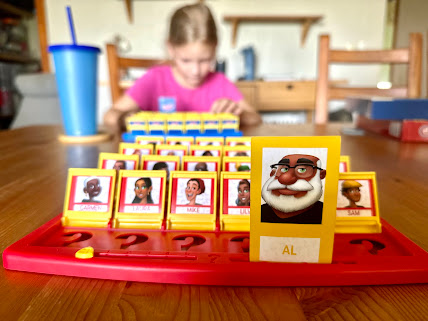
Today, we’re talking about Guess Who? – by all means a classic. I never actually owned this game growing up. It wasn’t until after I had kids of my own that we were gifted this cute and simple deduction game.

Guess Who? isn’t one that we’ve just played constantly. That doesn’t mean it’s not enjoyable; it can just get pushed to the back of the closet. We usually bring it out when we’ve gotten in a rut or when smaller kiddos are over to visit. At 13 and 12, my older kids are on the cusp of outgrowing it, but they still want in on the action when they see their little sis having fun playing.

As a teacher, I’ve gotten some good use out of Guess Who? in my classroom. I’ve taught English to second-language English speakers, and this game is helpful to practice using adjectives/expanding vocabulary. Or, just put it in a center and have your students write down sentences containing 3 adjectives to describe their character.

For me, there’s one small con. With the version we own, I sometimes get annoyed with the “pieces.” They can get a little twisted on the tiny metal rod they swing on, and I get low-key frustrated trying to flip the people back up when I start a new game. However, it’s not enough to make me quit playing. Plus, there are a ton of other versions available out there – each one appears to be designed a bit differently. (Perhaps I’ll do a Guess Who? round-up in the future!)


Number of players: 2

Game length: 10 minutes/round

Age: 6+

Object: Try to guess your opponent’s mystery person before he or she guesses your mystery person.

Rules Rundown: Here’s an online PDF of the rules. Choose a person from the stack of cards and keep it hidden from your opponent. Take turns asking “yes” and “no” questions in order to eliminate “suspects.” (i.e., “Does your person have brown eyes?” or “Is your person wearing a hat?”) Flip down any characters who do not hold the correct physical characteristic mentioned. The first person to guess correctly wins the round.

Ratings:
Cal – 10/10.
Leyton – 8/10.
Noah – 7/10.
Ang – 7/10.
Overall, I think it’s a solid add to your collection.

Dutch Blitz: A Tabletop Tales Review

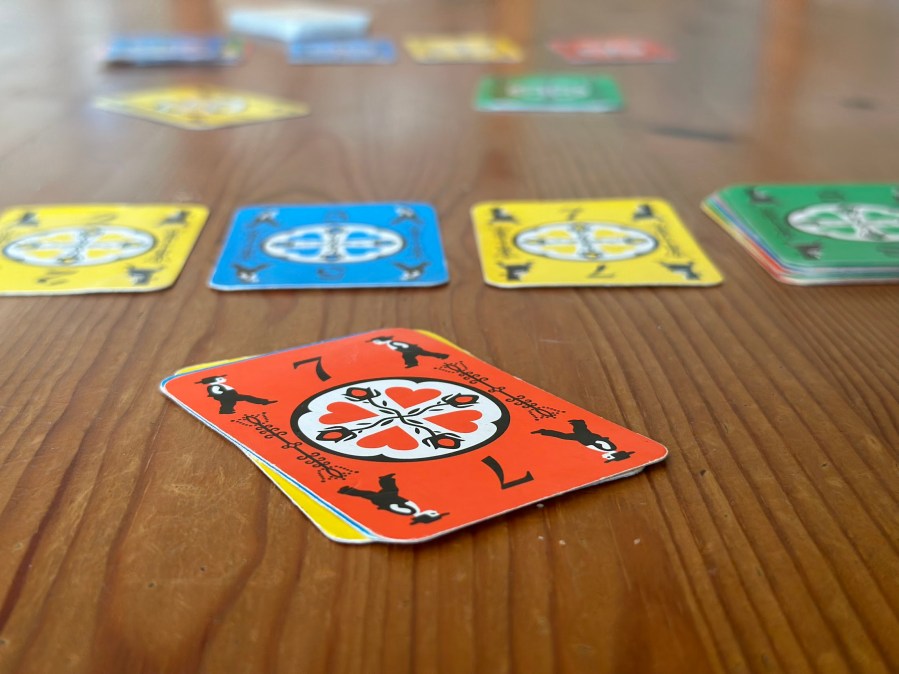
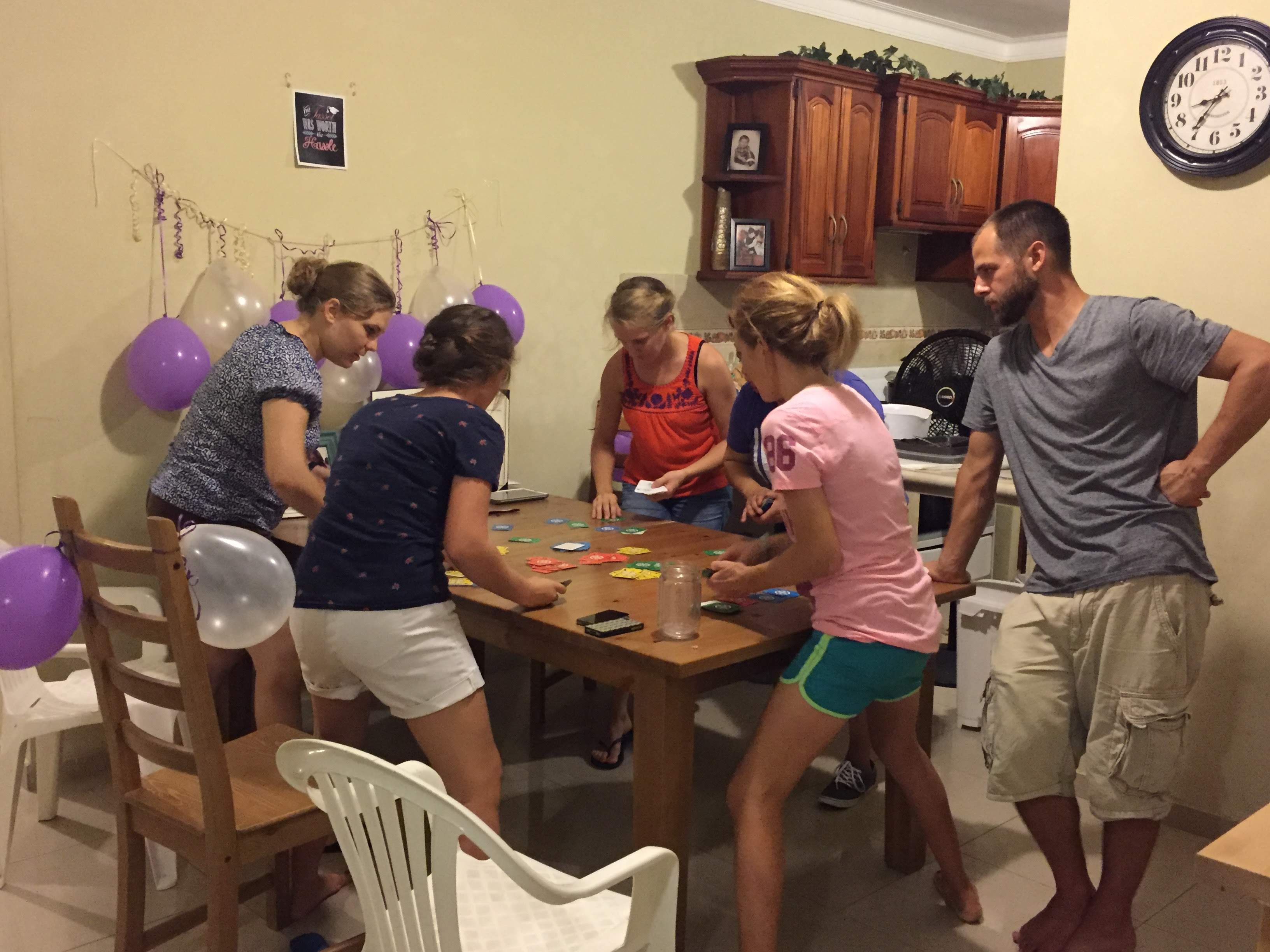
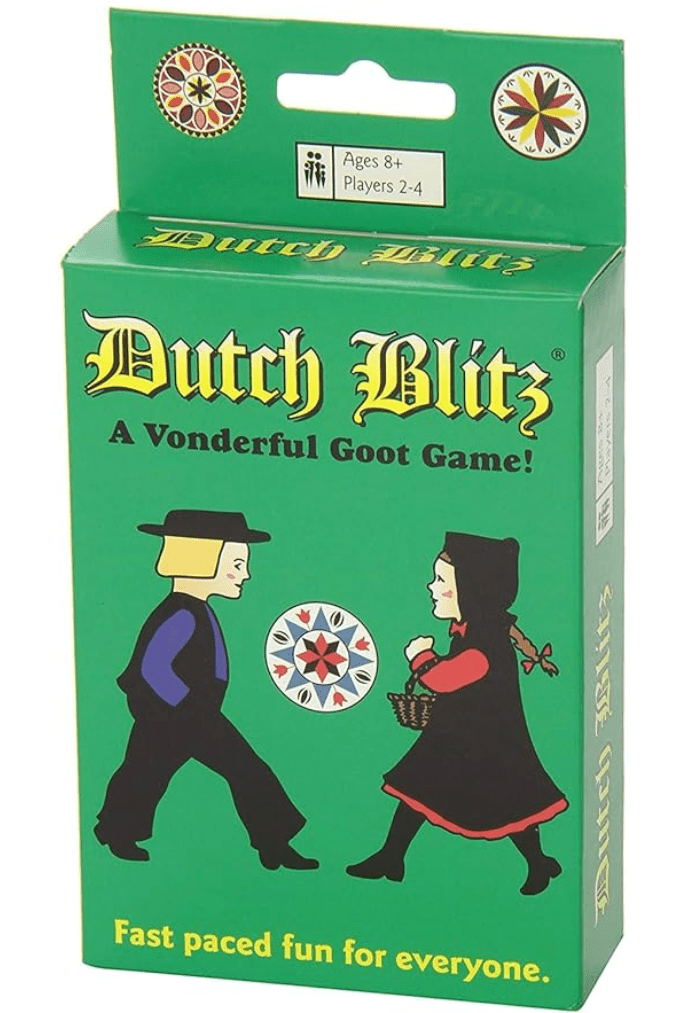
It would make sense that the first installment of “Tabletop Tales with the Mitcheners” would be a review of Dutch Blitz. This classic, fast-paced card game holds so many fond memories for me. My Grandma Vi introduced it to me when I was younger, and my brother and I quickly became obsessed. When we moved overseas, I was so happy to find that several of my fellow co-workers here in the DR also enjoyed it!

While it’s not a hard game to pick up, Dutch Blitz is definitely one where speed, dexterity, and careful attention to what’s coming next are necessary. If you’re a beginner, you may want to start by playing with a partner: one person watches the “Post” and “Blitz” pile while the other person flips the cards 3 at a time that are in hand.

I like Dutch Blitz because it’s easy to play across language barriers. There’s not a lot of talking required (other than the competitive banter that WILL ensue if someone steals your play). Dutch Blitz simply requires a basic understanding of the rules. We got Yuleisy hooked on it and have had many a loud evening laughing together.


Number of Players: 2-4 (Buy the “Expansion Pack” to up the maximum number of players to 8)

Age: 8+

Playing Time: 5ish minutes per round / Usually people want to move on after 30-45 minutes of play, but I’ve spent hours at a time playing tournaments

Object: Be the first to empty your personal pile of 10 “Dutch” cards by playing on ascending number piles in the middle of the table. Oh, and score the most points.

Rules Rundown: Whenever possible, I’ll link the rules to the original game. But I also understand that learning new games can be overwhelming. I’ll do my best to explain the gist of each game as simply as possible.

Each player has 2 main “piles”: 3 cards in the “Post” and a 10-card “Dutch” pile. The middle of the table will hold multiple “Blitz” piles that are shared by the entire group. When play starts, anyone can begin or play on an existing “Blitz” pile using the top card in his hand, the cards in his “Dutch” pile, or the cards in his “Post” pile. Simply play the next number in the sequence that matches that “Blitz” pile’s color! The round ends when someone exhausts his “Dutch” pile. Each player then counts the number of cards in his or her “Dutch” pile and subtracts 2 from the score for each remaining card; however, each card played into the “Blitz” piles in the middle counts as 1 point. First player to 75 points wins!

Ratings:
Perhaps it’s simply for nostalgia’s sake, but I give this a solid 8/10. I really could play this any time – except when super tired. Heh. I’ll be honest – Scott and the kiddos are not huge fans of it. I don’t think they love the fast-paced chaos. To each his own, I guess.

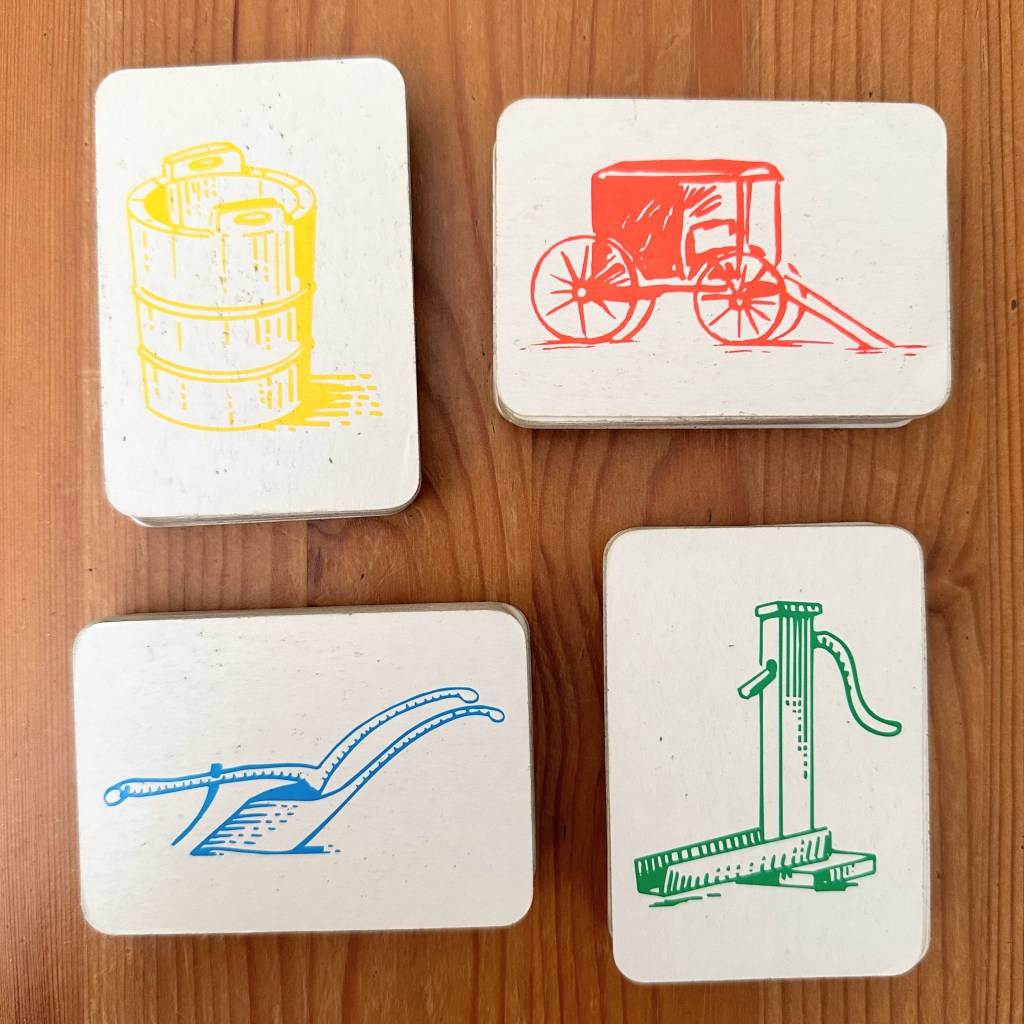
The only remaining question: which deck of cards will you choose? Team “Red Wagons” forever!